Författare
Carol Bacchi
Carol Bacchi är en uppskattad författare inom Samhälle och politik med totalt 5 böcker tillgängliga på Bokkollen, utgivna hos Palgrave Macmillan, Taylor & Francis Ltd, University of Adelaide Press.
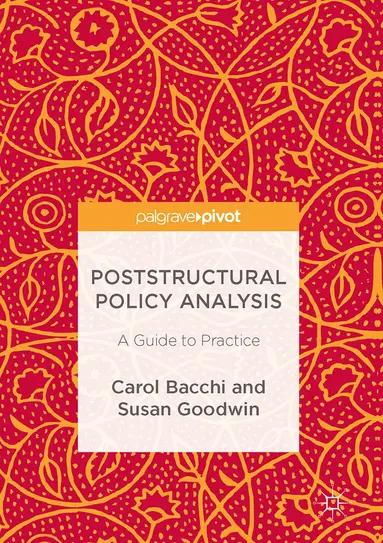
Bland verken finns Poststructural Policy Analysis, som toppar listan över Carol Bacchis populäraste böcker. Verken spänner över samhälle & politik och tilltalar läsare som uppskattar genren.
Det senast publicerade verket av Carol Bacchi är What's the Problem Represented to Be?, utgivet 2025.
Letar du efter något nytt att läsa? Prova Analysing Policy – ett annat uppskattat verk av Carol Bacchi.
På Bokkollen gör vi det enkelt att navigera i Carol Bacchis författarskap. Vår databas uppdateras ständigt med nya släpp och format, så oavsett om du söker efter en lättläst pocket för semestern, en lyxig inbunden presentutgåva eller en digital ljudbok för pendlingen, har vi rätt utgåva för dig.
Jämför snabbt och smidigt priser på alla böcker av Carol Bacchi hos Sveriges ledande bokhandlare – som Adlibris, Bokus och Akademibokhandeln – och hitta alltid det bästa erbjudandet utan att betala för mycket.
Poststructural Policy Analysis
This book offers a distinctive approach to policy analysis and a refreshing and politically engaged way of thinking about policy. It clearly articulates a Foucault-influenced poststructural perspective on policy and policy analysis for researchers, students and policy makers. As a "guide to practice", the book introduces a critical analytical approach to policy analysis called 'What's the Problem Represented to be?' (WPR). Instead of treating policy as simply the government's best efforts to address problems, this analytic strategy highlights how policies produce 'problems' as particular sorts of problem and how governing takes place through these problematisations. First published in 2016, the book describes the conceptual and theoretical underpinnings of the WPR approach to policy analysis in a detailed and accessible manner. It features examples of application of the approach with topics as diverse as obesity, economic policy, migration, drug and alcohol policy, and gender equality.In this second edition, the authors centralise a complementary analytic strategy for poststructural policy analysis-poststructural interview analysis (PIA). This edition integrates this material as a new chapter which sets out PIA as a novel approach to poststructural interview analysis and includes examples of PIA applications. The new chapter provides excellent guidance to undertake interview analysis in a manner congruent with the poststructural precepts set out in the book.
Hela bibliografin
Utforska alla Carol Bacchis publicerade verk sorterade efter popularitet.
Upptäck liknande författare
Om du gillar Carol Bacchi kommer du förmodligen att uppskatta även dessa författare inom samhälle & politik.