Författare
Franco "Bifo" Berardi
Franco "Bifo" Berardi är en uppskattad författare inom Samhälle och politik och Ekonomi och Ledarskap med totalt 8 böcker tillgängliga på Bokkollen, utgivna hos Autonomedia, Semiotext (E), University of Minnesota Press.
Bland verken finns Uprising, som toppar listan över Franco "Bifo" Berardis populäraste böcker. Verken spänner över ekonomi & ledarskap och tilltalar läsare som uppskattar genren.
Det senast publicerade verket av Franco "Bifo" Berardi är Chaos and the Automaton, utgivet 2025.
Letar du efter något nytt att läsa? Prova Precarious Rhapsody – ett annat uppskattat verk av Franco "Bifo" Berardi.
På Bokkollen gör vi det enkelt att navigera i Franco "Bifo" Berardis författarskap. Vår databas uppdateras ständigt med nya släpp och format, så oavsett om du söker efter en lättläst pocket för semestern, en lyxig inbunden presentutgåva eller en digital ljudbok för pendlingen, har vi rätt utgåva för dig.
Jämför snabbt och smidigt priser på alla böcker av Franco "Bifo" Berardi hos Sveriges ledande bokhandlare – som Adlibris, Bokus och Akademibokhandeln – och hitta alltid det bästa erbjudandet utan att betala för mycket.
Uprising
A manifesto against the concepts of growth and debt, and a call for a reinvestment in the social body.The Uprising is an Autonomist manifesto for today's precarious times, and a rallying cry in the face of the catastrophic and irreversible crisis that neoliberalism and the financial sphere have established over the globe. In his newest book, Franco "Bifo" Berardi argues that the notion of economic recovery is complete mythology. The coming years will inevitably see new surges of protest and violence, but the old models of resistance no longer apply. Society can either stick with the prescriptions and "rescues" that the economic and financial sectors have demanded at the expense of social happiness, culture, and the public good; or it can formulate an alternative. For Berardi, this alternative lies in understanding the current crisis as something more fundamental than an economic crisis: it is a crisis of the social imagination, and demands a new language by which to address it.This is a manifesto against the idea of growth, and against the concept of debt, the financial sector's two primary linguistic means of manipulating society. It is a call for exhaustion, and for resistance to the cult of energy on which today's economic free-floating market depends. To this end, Berardi introduces an unexpected linguistic political weapon-poetry: poetry as the insolvency of language, as the sensuous birth of meaning and desire, as that which cannot be reduced to information and exchanged like currency. If the protests now stirring about the world are to take shape and direction, then the revolution will be neither peaceful nor violent-it will be linguistic, or will not be at all.
Hela bibliografin
Utforska alla Franco "Bifo" Berardis publicerade verk sorterade efter popularitet.
Uprising
Franco "Bifo" Berardi
Från 146 kr
Breathing
Franco "Bifo" Berardi
Från 146 kr
Chaos and the Automaton
Franco 'Bifo' Berardi
Från 302 kr
And
Franco "Bifo" Berardi
Från 174 kr
Soul at Work
Franco "Bifo" Berardi
Från 174 kr
Precarious Rhapsody
Franco 'Bifo' Berardi
Från 162 kr
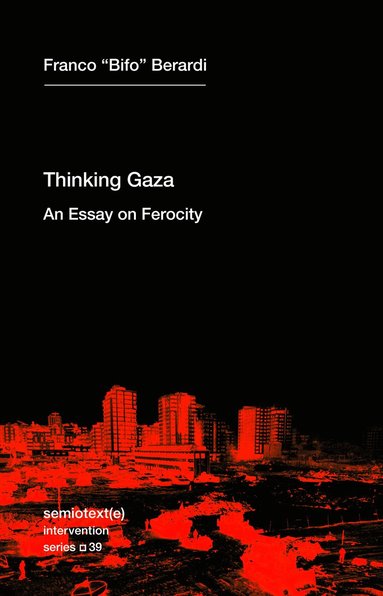
Thinking after Gaza
Franco Bifo Berardi
Från 249 kr

Den arbetande själen
Franco "Bifo" Berardi
Från 309 kr
Upptäck liknande författare
Om du gillar Franco "Bifo" Berardi kommer du förmodligen att uppskatta även dessa författare inom ekonomi & ledarskap.