Författare
Jay Watson
Jay Watson är en uppskattad författare inom Skönlitteratur med totalt 2 böcker tillgängliga på Bokkollen.
Bland verken finns Faulkner's Modernisms, som toppar listan över Jay Watsons populäraste böcker. Verken spänner över skönlitteratur och tilltalar läsare som uppskattar genren.
Letar du efter något nytt att läsa? Prova Faulkner's Modernisms – ett annat uppskattat verk av Jay Watson.
På Bokkollen gör vi det enkelt att navigera i Jay Watsons författarskap. Vår databas uppdateras ständigt med nya släpp och format, så oavsett om du söker efter en lättläst pocket för semestern, en lyxig inbunden presentutgåva eller en digital ljudbok för pendlingen, har vi rätt utgåva för dig.
Jämför snabbt och smidigt priser på alla böcker av Jay Watson hos Sveriges ledande bokhandlare – som Adlibris, Bokus och Akademibokhandeln – och hitta alltid det bästa erbjudandet utan att betala för mycket.
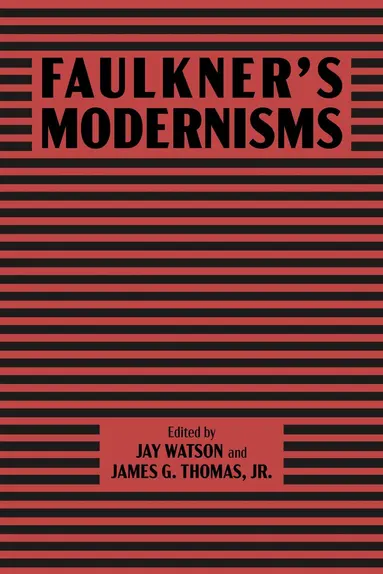
Faulkner's Modernisms
Contributions by Benjamin S. Child, Leigh Anne Duck, John N. Duvall, Amy A. Foley, Susan Stanford Friedman, Michael Gleason, Jolene Hubbs, Anne MacMaster, Sean McCann, Maggie E. Morris Davis, Julian Murphet, Ben Robbins, Benoît Tadié, Jay Watson, and Michael ZeitlinFew would dispute today that William Faulkner belongs among the front ranks of literary modernists, though he was not typically viewed in those terms when publishing his major works. But what sort of modernist-or modernists-was he? This collection examines the who, what, where, when, and how of Faulkner's modernism: its characters and cohort, its key subjects and themes, its locations and periodization, and its defining aesthetic strategies.The essays place Faulkner in dialogue with global modernists such as Virginia Woolf, James Joyce, Marcel Proust, and Richard Wright. Contributors explore his fascination with modern objects and architecture; his experiments in aviation and adaptation to avant-garde theater; the impact of modernity on childhood, family, and nation; his critique of eugenics, Fordism, and Taylorism; his phenomenology of race; and his movement from "high" to "late" modernism. They also question the very utility of the term "modernism" when applied to Faulkner's singular art. Faulkner's Modernisms offers a bracing reappraisal of one of the twentieth century's most challenging and idiosyncratic writers.
Hela bibliografin
Utforska alla Jay Watsons publicerade verk sorterade efter popularitet.
Upptäck liknande författare
Om du gillar Jay Watson kommer du förmodligen att uppskatta även dessa författare inom skönlitteratur.
Boktips inom skönlitteratur
Vårens gåtfulla läsning: Dan Browns nya thriller
Upptäck Dan Browns senaste thriller, en gåtfull vårsaga fylld av hemligheter och snabba vändningar.
Påskläsning – Liken vi begravde, en gåtfull berättelse
Upptäck den gåtfulla skönlitteraturen i Liken vi begravde – en påskläsning om död, minne och försoning som berör djupt.
Mörka aprilkvällar blir heta med Hembiträdets hemlighet
När aprilregnet smattrar mot rutan blir Hembiträdets hemlighet en het, gåtfull följeslagare som håller dig vaken hela natten.
Mellan blomsterdoft och stjärnljus – en vårbok
Upptäck Malin Haawinds poetiska debut där vårens blommor möter natthimlens klarhet. En bok som glimmar av hopp och stjärnljus.