Författare
Nicholas Dames
Nicholas Dames är en uppskattad författare inom Skönlitteratur med totalt 2 böcker tillgängliga på Bokkollen, utgivna hos Princeton University Press.
Bland verken finns Chapter, som toppar listan över Nicholas Damess populäraste böcker. Verken spänner över skönlitteratur och tilltalar läsare som uppskattar genren.
Letar du efter något nytt att läsa? Prova Chapter – ett annat uppskattat verk av Nicholas Dames.
På Bokkollen gör vi det enkelt att navigera i Nicholas Damess författarskap. Vår databas uppdateras ständigt med nya släpp och format, så oavsett om du söker efter en lättläst pocket för semestern, en lyxig inbunden presentutgåva eller en digital ljudbok för pendlingen, har vi rätt utgåva för dig.
Jämför snabbt och smidigt priser på alla böcker av Nicholas Dames hos Sveriges ledande bokhandlare – som Adlibris, Bokus och Akademibokhandeln – och hitta alltid det bästa erbjudandet utan att betala för mycket.
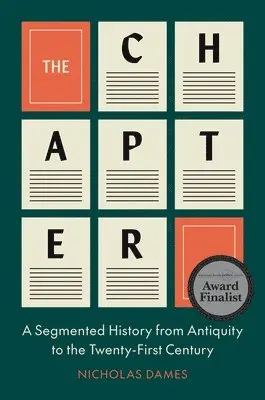
Chapter
Finalist for the National Book Critics Circle Award in CriticismShortlisted for the Christian Gauss Award, Phi Beta Kappa SocietyA history of the chapter from its origins in antiquity to todayWhy do books have chapters? With this seemingly simple question, Nicholas Dames embarks on a literary journey spanning two millennia, revealing how an ancient editorial technique became a universally recognized component of narrative art and a means to register the sensation of time.Dames begins with the textual compilations of the Roman world, where chapters evolved as a tool to organize information. He goes on to discuss the earliest divisional systems of the Gospels and the segmentation of medieval romances, describing how the chapter took on new purpose when applied to narrative texts and how narrative segmentation gave rise to a host of aesthetic techniques. Dames shares engaging and in-depth readings of influential figures, from Sterne, Goethe, Tolstoy, and Dickens to George Eliot, Machado de Assis, B. S. Johnson, Agnès Varda, Uwe Johnson, Jennifer Egan, and László Krasznahorkai. He illuminates the sometimes tacit, sometimes dramatic ways in which the chapter became a kind of reckoning with time and a quiet but persistent feature of modernity.Ranging from ancient tablets and scrolls to contemporary fiction and film, The Chapter provides a compelling, elegantly written history of a familiar compositional mode that readers often take for granted and offers a new theory of how this versatile means of dividing narrative sculpts our experience of time.
Hela bibliografin
Utforska alla Nicholas Damess publicerade verk sorterade efter popularitet.
Upptäck liknande författare
Om du gillar Nicholas Dames kommer du förmodligen att uppskatta även dessa författare inom skönlitteratur.
Boktips inom skönlitteratur
Vårens gåtfulla läsning: Dan Browns nya thriller
Upptäck Dan Browns senaste thriller, en gåtfull vårsaga fylld av hemligheter och snabba vändningar.
Påskläsning – Liken vi begravde, en gåtfull berättelse
Upptäck den gåtfulla skönlitteraturen i Liken vi begravde – en påskläsning om död, minne och försoning som berör djupt.
Mörka aprilkvällar blir heta med Hembiträdets hemlighet
När aprilregnet smattrar mot rutan blir Hembiträdets hemlighet en het, gåtfull följeslagare som håller dig vaken hela natten.
Mellan blomsterdoft och stjärnljus – en vårbok
Upptäck Malin Haawinds poetiska debut där vårens blommor möter natthimlens klarhet. En bok som glimmar av hopp och stjärnljus.