Författare
Rosi Braidotti
Rosi Braidotti är en uppskattad författare inom Samhälle och politik och Filosofi och religion med totalt 12 böcker tillgängliga på Bokkollen, utgivna hos John Wiley and Sons Ltd, Bloomsbury Publishing PLC, Columbia University Press.
Bland verken finns Posthuman Feminism, som toppar listan över Rosi Braidottis populäraste böcker. Verken spänner över samhälle & politik och tilltalar läsare som uppskattar genren.
Det senast publicerade verket av Rosi Braidotti är More Posthuman Glossary, utgivet 2022.
Letar du efter något nytt att läsa? Prova Transpositions – ett annat uppskattat verk av Rosi Braidotti.
På Bokkollen gör vi det enkelt att navigera i Rosi Braidottis författarskap. Vår databas uppdateras ständigt med nya släpp och format, så oavsett om du söker efter en lättläst pocket för semestern, en lyxig inbunden presentutgåva eller en digital ljudbok för pendlingen, har vi rätt utgåva för dig.
Jämför snabbt och smidigt priser på alla böcker av Rosi Braidotti hos Sveriges ledande bokhandlare – som Adlibris, Bokus och Akademibokhandeln – och hitta alltid det bästa erbjudandet utan att betala för mycket.
Posthuman Feminism
In a context marked by the virulent return of patriarchal and white supremacist attitudes, a new generation of feminist activists are continuing the struggle: these are very feminist times. But how do these and other movements relate to the contemporary posthuman condition? In this important new book, Rosi Braidotti examines the implications of the posthuman turn for feminist theory and practice. She defines the posthuman turn as a convergence between posthumanism on the one hand and post-anthropocentrism on the other, and she examines their complex relationship and joint impact. Braidotti claims that mainstream posthuman scholarship has neglected feminist theory, while in fact feminism is one of the precursors of the posthuman turn, through diverse social movements and political traditions. Posthuman Feminism is an analytic and creative response to contemporary conditions and a call to action. It highlights the constraints but also the potentialities available to feminist political subjects as they confront the ever-growing injustices of sexism, racism, ecocide and neoliberal capitalism. This bold new text by a leading feminist philosopher will be of great interest to students and scholars throughout the humanities and social sciences.
Hela bibliografin
Utforska alla Rosi Braidottis publicerade verk sorterade efter popularitet.
Posthuman Feminism
Rosi Braidotti
Från 217 kr
Posthuman Ecologies
Rosi Braidotti
Från 452 kr
Posthuman
Rosi Braidotti
Från 204 kr
Nomadic Theory
Rosi Braidotti
Från 317 kr
Posthuman Knowledge
Rosi Braidotti
Från 234 kr
Posthuman Glossary
Rosi Braidotti
Från 661 kr
More Posthuman Glossary
Rosi Braidotti
Från 306 kr
Transpositions
Rosi Braidotti
Från 271 kr
Deleuze and Law
Rosi Braidotti
Från 534 kr
Nomadic Subjects
Rosi Braidotti
Från 292 kr

Post-Nationalism
Rosi Braidotti
Från 159 kr
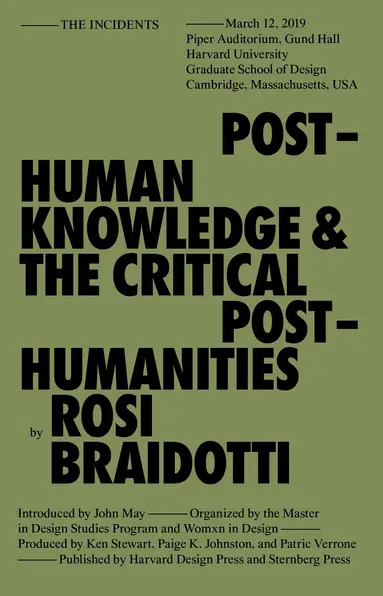
Posthuman Knowledge and the Critical Posthumanities
Rosi Braidotti
Från 309 kr
Upptäck liknande författare
Om du gillar Rosi Braidotti kommer du förmodligen att uppskatta även dessa författare inom samhälle & politik.