Författare
Yuk Hui
Yuk Hui är en uppskattad författare inom Filosofi och religion och Samhälle och politik med totalt 8 böcker tillgängliga på Bokkollen, utgivna hos Bloomsbury Publishing PLC, University of Minnesota Press, Meson Press Eg.
Bland verken finns Recursivity and Contingency, som toppar listan över Yuk Huis populäraste böcker. Verken spänner över samhälle & politik och tilltalar läsare som uppskattar genren.
Det senast publicerade verket av Yuk Hui är Machine and Sovereignty, utgivet 2024.
Letar du efter något nytt att läsa? Prova Cosmotechnics – ett annat uppskattat verk av Yuk Hui.
På Bokkollen gör vi det enkelt att navigera i Yuk Huis författarskap. Vår databas uppdateras ständigt med nya släpp och format, så oavsett om du söker efter en lättläst pocket för semestern, en lyxig inbunden presentutgåva eller en digital ljudbok för pendlingen, har vi rätt utgåva för dig.
Jämför snabbt och smidigt priser på alla böcker av Yuk Hui hos Sveriges ledande bokhandlare – som Adlibris, Bokus och Akademibokhandeln – och hitta alltid det bästa erbjudandet utan att betala för mycket.
Recursivity and Contingency
This book employs recursivity and contingency as two principle concepts to investigate into the relation between nature and technology, machine and organism, system and freedom. It reconstructs a trajectory of thought from an Organic condition of thinking elaborated by Kant, passing by the philosophy of nature (Schelling and Hegel), to the 20th century Organicism (Bertalanffy, Needham, Whitehead, Wiener among others) and Organology (Bergson, Canguilhem, Simodnon, Stiegler), and questions the new condition of philosophizing in the time of algorithmic contingency, ecological and algorithmic catastrophes, which Heidegger calls the end of philosophy.The book centres on the following speculative question: if in the philosophical tradition, the concept of contingency is always related to the laws of nature, then in what way can we understand contingency in related to technical systems? The book situates the concept of recursivity as a break from the Cartesian mechanism and the drive of system construction; it elaborates on the necessity of contingency in such epistemological rupture where nature ends and system emerges. In this development, we see how German idealism is precursor to cybernetics, and the Anthropocene and Noosphere (Teilhard de Chardin) point toward the realization of a gigantic cybernetic system, which lead us back to the question of freedom. It questions the concept of absolute contingency (Meillassoux) and proposes a cosmotechnical pluralism. Engaging with modern and contemporary European philosophy as well as Chinese thought through the mediation of Needham, this book refers to cybernetics, mathematics, artificial intelligence and inhumanism.
Hela bibliografin
Utforska alla Yuk Huis publicerade verk sorterade efter popularitet.
Recursivity and Contingency
Yuk Hui
Från 502 kr
On the Existence of Digital Objects
Yuk Hui
Från 283 kr
30 Years after Les Immatériaux
Yuk Hui
Från 175 kr
Post-Europe
Yuk Hui
Från 176 kr
Machine and Sovereignty
Yuk Hui
Från 312 kr
Cosmotechnics
Yuk Hui
Från 576 kr
Recursivity and Contingency
Yuk Hui
Från 1 508 kr
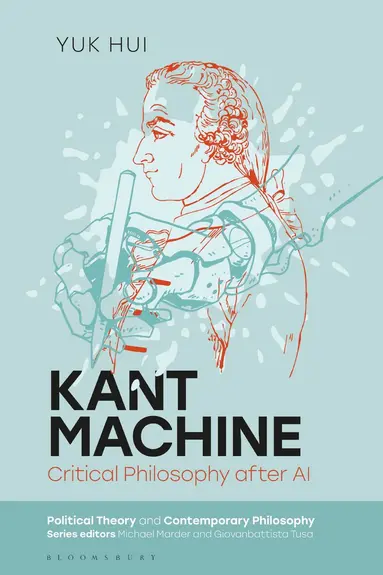
Kant Machine
Yuk Hui
Från 349 kr
Upptäck liknande författare
Om du gillar Yuk Hui kommer du förmodligen att uppskatta även dessa författare inom samhälle & politik.