Författare
Zi-Ling Yan
Zi-Ling Yan är en uppskattad författare inom Skönlitteratur med totalt 1 bok tillgängliga på Bokkollen.
Bland verken finns Framing the Clue-Puzzle, som toppar listan över Zi-Ling Yans populäraste böcker. Verken spänner över skönlitteratur och tilltalar läsare som uppskattar genren.
På Bokkollen gör vi det enkelt att navigera i Zi-Ling Yans författarskap. Vår databas uppdateras ständigt med nya släpp och format, så oavsett om du söker efter en lättläst pocket för semestern, en lyxig inbunden presentutgåva eller en digital ljudbok för pendlingen, har vi rätt utgåva för dig.
Jämför snabbt och smidigt priser på alla böcker av Zi-Ling Yan hos Sveriges ledande bokhandlare – som Adlibris, Bokus och Akademibokhandeln – och hitta alltid det bästa erbjudandet utan att betala för mycket.
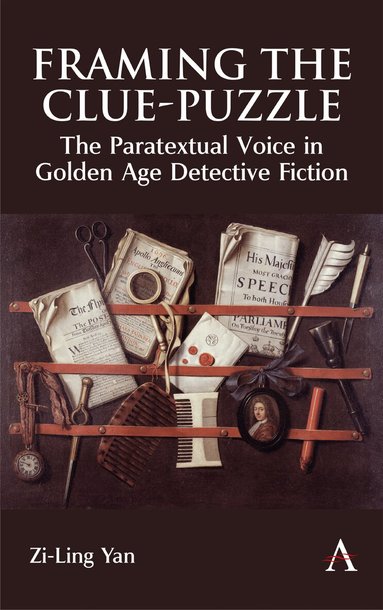
Framing the Clue-Puzzle
Explores how para texts in detective fiction impact the construction of meaning, revealing how narrative framing shapes knowledge, justice, and interpretation.Zi-Ling Yan's Framingthe Clue Puzzle examines a familiar but unsystematically addressed and understudied feature of much Golden Age detective fiction: the conscious incorporation of paratexts into the mystery narrative. After examining Gérard Genette's pioneering work on paratexts and recent criticism concerned with their literary applications, Yan draws upon Dan Sperber and Deidre Wilson's Relevance Theory and Richard Walsh's notion of fictionality to develop an approach in which paratexts are understood to exert framing functions by implicature while, because they are subsumed in the text, only mimicking metalepsis. This understanding of the fictive paratext is then applied to a data set consisting of 530 detective narratives divided into five core chapters covering prefaces, footnotes, maps, floorplans, and diagrammatic devices. The results disclose consistent patterns of development between para- or intra-textual types over time and within subgenres: a trickle of paratextual material in the late nineteenth-century Classical period of the genre, notable increases during the 1920s, which peak the 1930s and subside in the 1940s, bracketing the Golden Age clue-puzzle.The chapter sequence is built upon several criteria: degree of paratextual independence or integration, physical placement, and the rhetorical aspects of voice evoked by the problem of the para-/intra-textual locus of enunciation. The movement is from detachable, more personalized elements visibly situated at the margin to increasingly anonymous figures which are more integrated and internal. The depersonalization of voice coincides with the progressive obfuscation of agency and subtler dimensions of framing that evoke forms speaking as forms. Once brought to notice as objects to be studied rather than thresholds mutely registering as transmissive features of discourse, their incidence raises several questions pertaining to their historical appearance, to their normative framing capacity, and relatedly, to how they serve discursively as guarantors of content beyond their attribution to characters, narrators, or authors. In short, I show how in this capacity they are linked to the promotion of certain types of knowledge and concepts of justice contained in the pages they frame.
Hela bibliografin
Utforska alla Zi-Ling Yans publicerade verk sorterade efter popularitet.
Upptäck liknande författare
Om du gillar Zi-Ling Yan kommer du förmodligen att uppskatta även dessa författare inom skönlitteratur.
Boktips inom skönlitteratur
Vårens gåtfulla läsning: Dan Browns nya thriller
Upptäck Dan Browns senaste thriller, en gåtfull vårsaga fylld av hemligheter och snabba vändningar.
Påskläsning – Liken vi begravde, en gåtfull berättelse
Upptäck den gåtfulla skönlitteraturen i Liken vi begravde – en påskläsning om död, minne och försoning som berör djupt.
Mörka aprilkvällar blir heta med Hembiträdets hemlighet
När aprilregnet smattrar mot rutan blir Hembiträdets hemlighet en het, gåtfull följeslagare som håller dig vaken hela natten.
Mellan blomsterdoft och stjärnljus – en vårbok
Upptäck Malin Haawinds poetiska debut där vårens blommor möter natthimlens klarhet. En bok som glimmar av hopp och stjärnljus.